

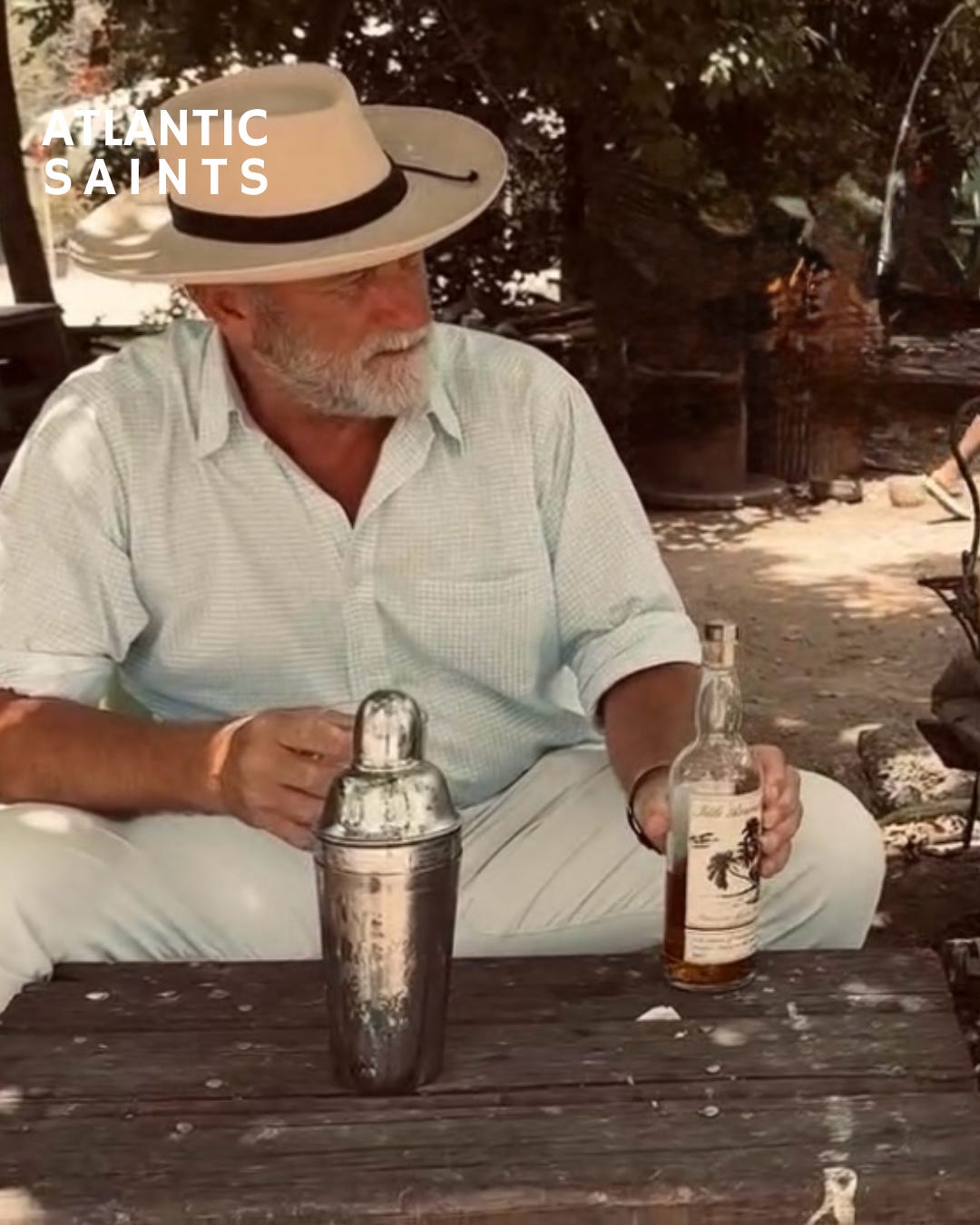
David Flint Wood is one of my new favorite conversationalists. He is witty, kind, and willing to entertain a tangent. In short, he is perfect to pass the time with.
The Englishman, who is a hotelier turned decorator turned island raconteur, has spent three decades on Harbour Island cultivating a sensibility he cheerfully calls “sepia-toned.”
He refers to Instagram as “a collections of postcards to the world” which has, in recent years, become for him the shop window for his latest enterprise: Idle Assembly, a premium aged rum that is equal parts restraint, romance, and very good taste.
The rum’s origin story could be a Slim Aarons frame: a Sunday morning at a polo ground in England, South Americans “stabling their ponies,” a woman presenting a bottle from her family’s Colombian distillery, and an offhand introduction that changed everything.
“I gave them a brief of the sort of rum I wanted: very much Latin American, very much smooth, and quite cool. I didn’t like that burn you get from drinking neat spirits.”
The result is a blend of 5-20 year old rums that has made even non-aficionados blink. “I’ve been with people sipping our rum who say ‘OK, is that what rum tastes like?’”
The name Idle Assembly came from a sign at Harbour Island’s Government Dock, a charming list of rules ends with the golden commandment: No Loafing or Idle Assembly.
Flint Wood smiled and filed it away.
“Gathering in public with no purpose,” he says. “is our entire purpose – to get together with friends and not do very much. Having a rum called Idle Assembly was kind of perfect.”
If the name is a wink, the design is a manifesto of restraint. “I think the booze world often believes premium requires heavy, cut-glass decanters with gold stoppers and silk boxes,” he says. “My feeling was to underplay it, show some confidence.”
So Idle Assembly arrives in the most honest vessel of all: the ubiquitous single-malt bottle with a cork topper, dressed in a two-color label on unexpectedly great paper. The bottle is wrapped in tissue printed with a naval chart of the islands and slipped into a little jute sack. It’s like a tactile story you can hold.
“It’s amazing how many people pick up the bottle and immediately play back what you’re hoping,” he says. “Aged, understated, a sense of humor. It’s good stuff that doesn’t need to shout.”
For all the elegance, Flint Wood is disarmingly candid about the grind. “When you’ve got your own money in something,” he says, “it really ‘sorts the smokers out from the skin divers’” - an ad-man’s line he delivers with relish. Promises sometimes fail to turn to orders, followed by sudden breakthroughs.
“Then you meet someone who goes, ‘My God, this is fantastic,’ and you’re stocked at Fortnum & Mason, the River Cafe, or with Michelin Star Tom Kitchin in Scotland designing cocktails around it.” He grins. “It makes you think you might actually be quite good at this.”
Advertising still shapes his instinct. He came up in the last gust of the Mad Men era, tutored, at least philosophically, by David Ogilvy. “A brand is a tone of voice and a character you add to a product, which lends it desirability,” Flint Wood says. “Ralph Lauren was genius at this; you bought an Oxford shirt and thought you were getting a yacht with it.”
Idle Assembly plays that note differently: less yacht, more slip of pink customs house, a dock at golden hour, laughter carrying over the water.
Distribution, too, is done his way. Flint Wood and his partner sell directly to consumers where allowed. “We can deliver to your door in much of America,” he says. “It’s better for people and better for us.” The scale is boutique but real.
“Somehow in 2½ years we’ve sold a good amount of rum,” he says, equal parts pleased and surprised. “For two guys (one on an island in the Bahamas and one in Edinburgh), neither of whom knew what the **** they were talking about, that’s pretty good.”
The through line is hospitality. Long before the label, he and his wife, India, revived The Landing, a storied inn on Bay Street. “For four or five years The Landing was the hot diggity-doo of the Out Islands,” he recalls. “Crowned heads and rock stars next to photographers, businessmen, junkies and thieves … and the place looked the part.”
What made it sing wasn’t bling but narrative: the way a room leads the eye, the right table laid with care, the sense that you’ve stepped into a story. Idle Assembly borrows that grammar and puts it in your glass.
For all the wit, there’s a quietly serious philosophy under the varnish. Ask what he hopes someone is toasting 50 or 100 years from now, opening a long-forgotten bottle of Idle Assembly, and the answer arrives without varnish: “Probably that, probably getting together with friends and wasting time.”
Then, with the kind of English clarity that lands as wisdom: “Idleness is an enormously important part of life. It’s not being pressured and angry and wracked with anxiety. Sit with mates on a veranda or New York or London or on a dock somewhere and just shoot the breeze. Open a bottle and start telling stories.”
Flint Wood’s story is the story of Idle Assembly: both rebellious and deeply faithful, both independent as the islands and rich with family, both substance and flair.
The rum inside his glass is exactly what he asked those Colombian blenders for: suave, Latin, cool. It is also, in his words, “smooth and easy to get along with,” like the man himself.
As we finish, talk returns to tone and what to show and what to leave unsaid. “It’s important to have a tone of voice and stick to it,” he says. “And sometimes the best move is restraint.”
A conversation with David Flint Wood and a glass of Idle Assembly prove the point: an elegant measure of understatement, best served with friends, stories, and time to spare.


