

The Rolex Daytona was once the watch nobody wanted. Dealers would throw it in for “a couple hundred bucks” to good customers. However, what the market ignored has become the thing everyone now covets.
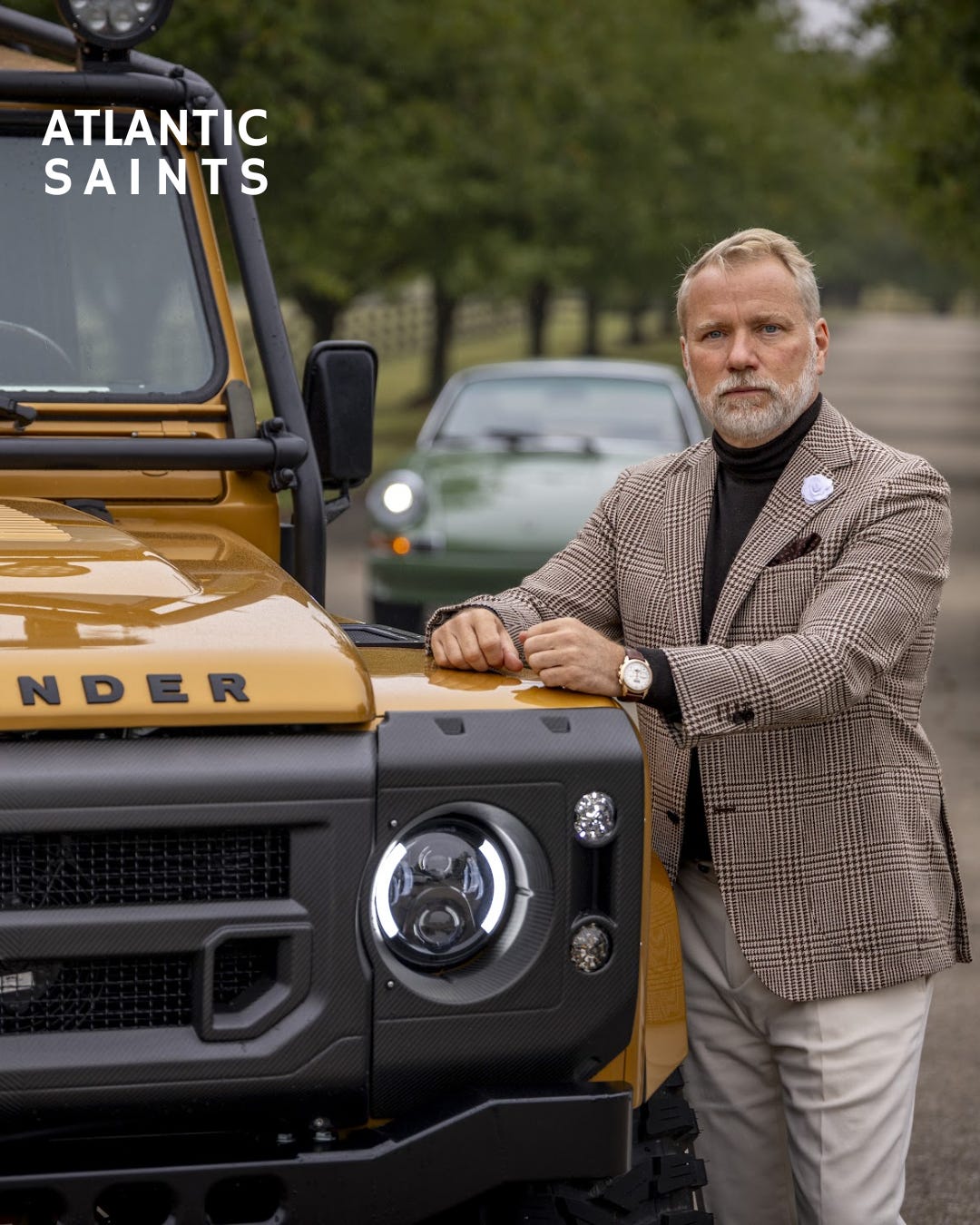
Paul Potratz understands that arc instinctively. He was the quiet kid. He admired the misfits of motoring—old Defenders, air-cooled Porsches, café racers—when flashier novelties were easier to love. He prefers things with miles and memory.
“I’ve always been into vehicles—very specific vehicles—because that’s just my personality,” he says. “My dad wasn’t wealthy. He believed in having fewer items, but some of the best. People confuse ‘best’ with expensive. It’s not. It’s best quality.”
The education began, as the best ones do, at the kitchen table: catalogs, word-of-mouth, friends trading notes about Woolrich coats and bicycles and tools. “I’d sit on the sideline of those conversations,” he remembers. The taste took root—a curator’s eye for the rare and the handmade—while life raced forward.
Potratz built an advertising firm and a software company, living on planes and in hotels, “gone an average of 200 days out of the year,” saying yes to the grind until genetics tapped his shoulder.
His father died at 54; his grandfather at 52.
“I was always concerned I’d have the same heart disease,” he says. For Potratz, a deep perspective and an appreciation of each day, set in. He fixed his diet and took a purposeful look at his life.
Then the world stood still. Covid pushed him back to his farm and into a different tempo. An introvert by nature, he found restoration to be the purest therapy— reviving battered Land Rovers and old Porsches, fueled by research done with the zeal of a scholar.
“Part of the joy is doing the research,” he says. “Learning puts me back in control. We think we control things. We don’t. But when you negotiate a purchase, decide the spec—that’s a fleeting moment of control.”
Steel, stitch, and torque answer back when the markets don’t.
Helderburg arrived almost by accident and entirely by intent. He wanted a single word with Germanic backbone—“I didn’t want to use ‘Potratz’ as I thought it would confuse employees and clients”—and a place to share what he loved. He posted, he wrote, he photographed, and the like-minded found him.
Helderburg shifted when a gentleman in Brooklyn who asked politely if one of Paul’s Defenders might be available. “We had similar interests—dogs, the outdoors, motorcycles, watches… I liked him.”
One handover led to another; soon there was a waiting list and, more importantly, a brief: build the Defender you’d build for yourself, just this once for me.
Helderburg, led by Potratz, is now one of the premier Defender restorers in the world.
If Helderburg has rules, they are mostly about restraint. “Clients will say, ‘I want you to design something for me’—lift or no lift, exterior color, interior stitching,” he says, delighted by the creative latitude.
But he’s quick to steer away from the allure of modern gadgetry. “If they start asking for air-conditioned seats, power moonroof, ABS, a Corvette engine… I stop it. This isn’t for you. Just go buy another G-Wagon.”
The point is not novelty; it’s fidelity.
A Helderburg Defender ought to be the sort of heirloom you keep long enough to pass down.
“People fall in love with the idea of a Defender because they want something different than their neighbor’s car,” he says. “They’re buying for the flash, not the nostalgia. I refuse to sell in those cases.”
Place is part of the romance. Paul lives now in Arkansas, a place he discovered via the curated vintage-Porsche Overcrest Rally. There he found roads as sinuous as Swiss switchbacks, people as gracious as old friends, and a French-country house with a tree-lined drive that checked every box he’d described to his wife when they first met.
“I don’t worry about the stereotype of a Arkansas,” he shrugs. “It’s incredible and I like what I like.”
For a man whose past life ran on bell schedules and boarding times, his present is a quiet rebellion. Breakfast with his wife replaced breakfasts on the run. “Before, it was coffee and out the door,” he says.
Now there’s a ritual: the porch swing, the dogs, the sometimes two-hour pause to think, journal, or simply watch the wind comb the pasture. The phone goes off; the bookstore calls. “I pick and choose,” he says. “I’m living in the present right now.” Forecasts and unit counts—the spoils of his earlier career—have evaporated. “I don’t know how many Defenders I’ve sold,” he admits with a laugh. “I’m working on a headlight design today. That’s enough.”
The motorcycles fit the brief—Ducati and Norton café racers rather than techno tourers—machines that answer to the wrist and the ear.
The watches follow the same logic. “I’m drawn to manual wind,” he says. “Every morning I choose a watch and wind it. I love the sound—click, click, click. Those are the minutes of the day.”
The ritual is inheritance; he remembers his father showing him how to wind a watch before dawn. Objects, like people and Defenders, reveal themselves over time for Potratz.
Helderburg itself is being built to outlast him. Paul recently made his longtime builder an equity partner in the enterprise. “There was no reason to,” he says with a shrug, “except I don’t have kids, and it needs to continue. He has children and he has the passion.”
“Enjoy life. Don’t take away from anyone else’s life. I’m anti-drama… If someone’s being a jerk, I move out of that situation.” Potratz’s enjoyment of marriage gleams through every sentence—breakfasts together, the shared horses, the impulse purchase of a house that “had my name all over it.”
If there’s a north star, it’s less accumulation than appreciation: fewer things, better things, lived with long enough to develop a soul.
Which brings us back to the Daytona—unwanted at birth, adored in maturity.
Helderburg’s Defenders are cut from the same hide: honest, mechanical, beautiful because they’ve earned it. So is their maker, the quiet kid who now builds a legacy you can drive.
“When I’m gone,” Potratz says, “I want people to say, ‘It’s a classic Land Rover—but it was built by Helderburg.’ And smile.”
In a world still obsessed with newness, there’s elegance—and a certain courage—in choosing the long game.


